Understanding Indoor Air Quality Challenges in Estero, FL
Living in Estero means dealing with unique environmental conditions that significantly impact the air quality inside your home. The subtropical climate creates a perfect storm of humidity, heat, and outdoor pollutants that can infiltrate indoor spaces throughout the year. When outdoor temperatures soar above 90 degrees for months at a time, your air conditioning system runs almost continuously, circulating whatever particles and contaminants have accumulated in your ductwork and living spaces. The proximity to both the Gulf of Mexico and inland wetlands introduces additional moisture and biological contaminants that standard filtration systems often struggle to manage effectively.
At Accurate Comfort Services, we’ve been addressing these regional challenges since 1975, developing comprehensive solutions that account for Southwest Florida’s distinctive climate patterns. The combination of salt air from coastal breezes, pollen from subtropical vegetation, and year-round humidity levels averaging 75% creates an environment where indoor air quality requires specialized attention and equipment designed specifically for these conditions.
Common Indoor Air Pollutants in Southwest Florida Homes
The warm, humid conditions prevalent in Estero create ideal breeding grounds for various biological contaminants that affect indoor air quality. Mold spores thrive in environments where humidity levels exceed 60%, and without proper ventilation and dehumidification, these microscopic organisms can proliferate rapidly behind walls, in air ducts, and around air conditioning components. Dust mites, another common allergen, multiply exponentially in humid conditions, with populations doubling every few weeks when humidity remains high. These microscopic creatures feed on dead skin cells and produce waste products that become airborne, triggering allergic reactions and respiratory issues in sensitive individuals.
Beyond biological contaminants, volatile organic compounds (VOCs) present another significant concern for indoor air quality. These chemicals emanate from common household items including cleaning products, paint, furniture, and building materials. In tightly sealed, energy-efficient homes designed to minimize cooling costs, these compounds can accumulate to levels five times higher than outdoor concentrations. Our NATE-certified technicians regularly encounter homes where inadequate ventilation has allowed VOCs to reach levels that cause headaches, fatigue, and respiratory irritation among residents.
Advanced Filtration Solutions and Technologies
Modern air purification technology has evolved far beyond basic fiberglass filters, offering sophisticated solutions that capture particles as small as 0.3 microns. HEPA filtration systems, when properly integrated into existing HVAC infrastructure, can remove 99.97% of airborne particles, including pollen, pet dander, and many bacteria. These systems work by forcing air through a fine mesh that traps harmful particles while allowing clean air to circulate throughout your home. The key to maximizing their effectiveness lies in proper sizing and installation, ensuring that all air passing through your system receives adequate filtration without restricting airflow that could damage equipment or reduce efficiency.
UV germicidal lights represent another powerful tool in maintaining superior indoor air quality. These systems use ultraviolet light at specific wavelengths to destroy the DNA structure of microorganisms, preventing them from reproducing and spreading throughout your home. When installed within air handling units, UV lights continuously sterilize air as it passes through the system, eliminating up to 99% of airborne bacteria, viruses, and mold spores. As a Carrier Factory Authorized Dealer, we install UV light systems that integrate seamlessly with existing equipment, providing continuous protection without requiring frequent maintenance or filter replacements.
Humidity Control and Ventilation Strategies
Managing humidity levels represents one of the most critical aspects of maintaining healthy indoor air quality in Estero. Optimal indoor humidity should remain between 30% and 50%, but achieving this balance requires more than just running your air conditioner. Whole-home dehumidification systems work independently of temperature control, removing excess moisture even when cooling isn’t needed. These systems can extract up to 100 pints of water from indoor air daily, preventing mold growth, reducing dust mite populations, and creating a more comfortable living environment even at higher thermostat settings.
Proper ventilation ensures fresh outdoor air enters your home while stale, contaminated air exits, maintaining a healthy balance without compromising energy efficiency. Energy recovery ventilators (ERVs) accomplish this by transferring heat and humidity between incoming and outgoing air streams, minimizing the energy penalty associated with ventilation. During summer months, ERVs pre-cool and dehumidify incoming air using the conditioned exhaust air, reducing the load on your air conditioning system while ensuring adequate fresh air circulation.
Professional Assessment and Customized Solutions
Every home presents unique indoor air quality challenges based on factors including construction materials, occupancy patterns, and surrounding environment. Our comprehensive indoor air quality assessments begin with detailed measurements of particulate levels, humidity, temperature variations, and air circulation patterns throughout your home. Using professional-grade monitoring equipment, we identify specific problem areas and contamination sources that standard inspections might miss. This data-driven approach allows us to recommend targeted solutions rather than one-size-fits-all approaches that may not address your specific concerns.
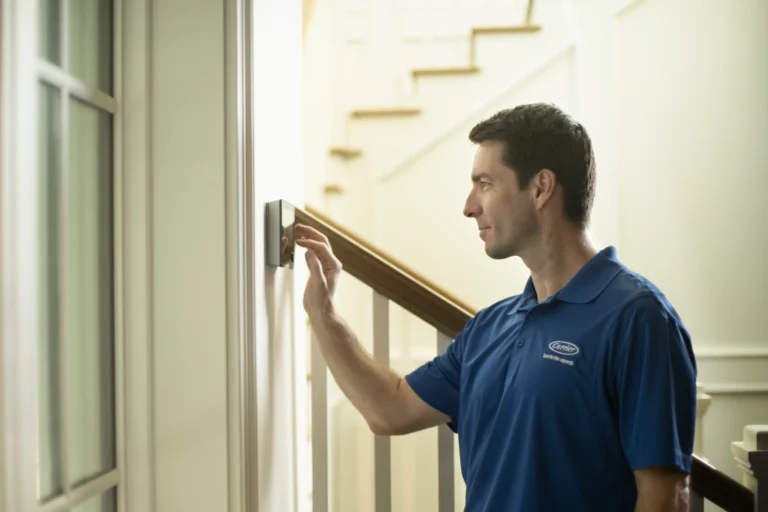
Our technicians, who receive specialized training through Carrier and participate in continuing education every week, understand the intricate relationships between various indoor air quality factors. Recognition such as the Carrier President’s Award reflects our commitment to excellence in both technical expertise and customer service. We analyze how your existing HVAC system operates, identifying opportunities to improve filtration, ventilation, and humidity control without requiring complete system replacement.
Implementing Your Indoor Air Quality Improvement Plan
Creating healthier indoor air involves strategic implementation of multiple technologies working in concert. The process typically begins with sealing duct leaks that allow unconditioned air and contaminants to enter your system, followed by upgrading filtration capabilities to capture smaller particles.
- Initial system cleaning and sanitization: Remove accumulated contaminants from ductwork and equipment
- Filter system upgrade: Install appropriate MERV-rated filters or HEPA systems based on specific needs
- Humidity control implementation: Add dehumidification or humidification as needed
- UV light installation: Position germicidal lights for maximum effectiveness
- Ventilation enhancement: Integrate fresh air systems while maintaining energy efficiency
Regular maintenance ensures these systems continue operating at peak effectiveness, with filter replacements, UV bulb changes, and system adjustments based on seasonal requirements. Our service area throughout the greater Naples and Marco Island region, including Lely, Golden Gate, Vineyards, and Bonita Springs, means we understand the specific challenges each community faces regarding indoor air quality, from coastal salt exposure to inland agricultural particles, allowing us to tailor solutions accordingly for optimal results.